

By Lacey Norton, Commercial & Operations Executive
Every Thursday, THE BOARD brings you industry insights from our Members to your inbox.
THE ARCHITECTURE OF IMMERSIVE BRAND EXPERIENCES: WHERE DESIGN, SYSTEMS, AND THE CULTURE CONVERGE. (THIS WEEK PART ONE, NEXT WEEK PART TWO).
Building the operational foundations that make immersive, human experiences possible.

As we enter 2026, conversation across industries is converging around the renewed investment in IRL experiences, and their power to bring a brand’s purpose to life through meaningful connection and differentiation.
With digital spaces becoming increasingly chaotic and saturated, and the cost of acquiring new customers online continuing to rise, brands are being reminded of something fundamental: humans are hardwired for connection. As a result, we’re witnessing a shift back toward physical experiences - and in their most expansive form, world building - the creation of spaces, activations, and environments designed to bring a brand’s purpose to life and enable meaningful human engagement.
In a recent Fast Company article, more than 80% of customers believe that the experience a company provides is as important as the products and services it offers, and brands continue to expand their experiential budgets as customer expectations evolve, highlighting that experience has become a strategic business differentiator, not just a nice-to-have.

That said, creating immersive experiences that are both engaging and scalable is not easy. It requires meaningful financial investment and a clearly defined design framework, mirrored by the same rigor in operational architecture and training to ensure the experience comes to life as intended. Bringing these dimensions together, creative and operational, is what transforms an idea into an experience that feels authentic and true to intent.
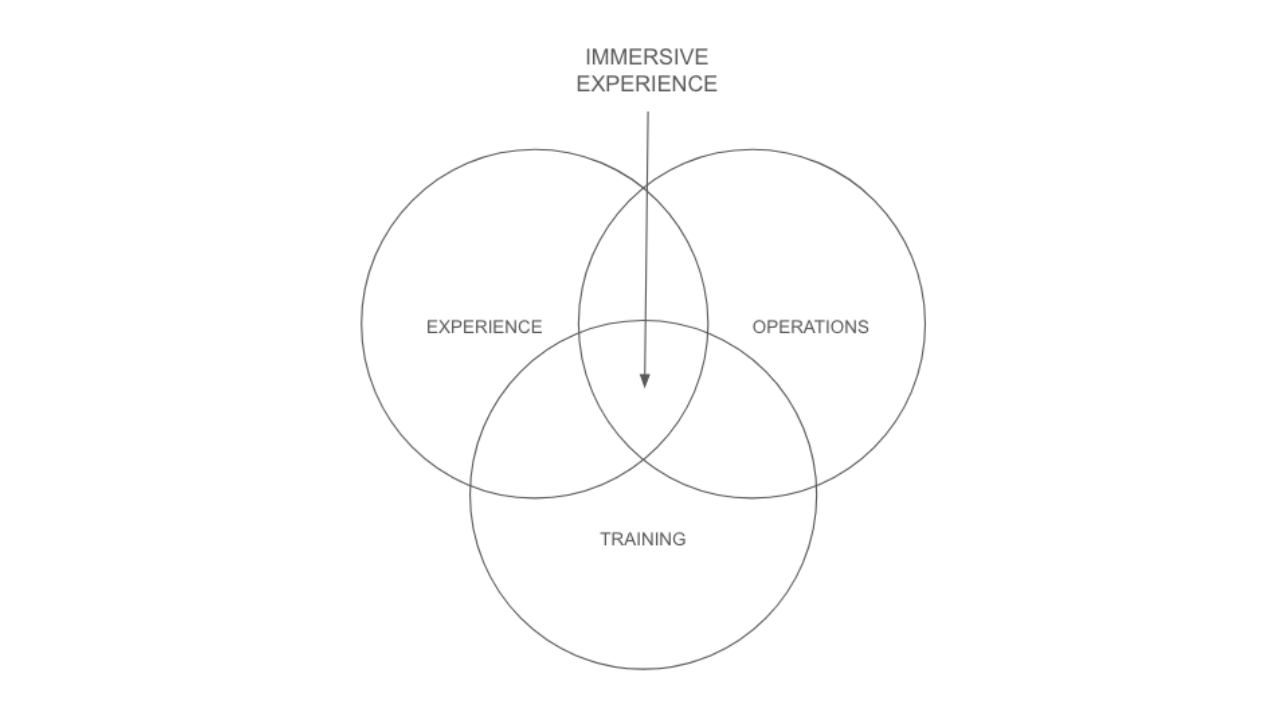
1. DEFINING THE EXPERIENCE.
Before designing an experience, it’s critical to define what you want it to achieve and how success will be measured. Experiences represent significant investments: clarity on metrics ensures those investments deliver impact. This is especially true for brands that have long operated in digitally led environments, where the value of physical engagement may be less familiar.
Success might be measured by revenue, brand awareness, user-generated content, or a combination of factors. Whatever the goal, it must be clearly defined at the outset to align the design and provide a clear framework for evaluating success.
Once success metrics are established, the creative work begins. The experience should clearly reflect the brand’s purpose, and bring the brand's story to life. Whether large-scale or intimate, every detail should be considered, evoking the emotion and connection the brand wants to inspire. The most powerful experiences are unmistakably true to the brand and unmistakably human.
2. BUILDING THE OPERATIONAL ARCHITECTURE.
Once the experience design has been defined, the same rigor must be applied to building the operational framework that will bring it to life. This includes defining the operational pillars, systems, SOPs, and playbooks, the foundational tools that ensure the experience is both operationally viable and executed according to intent.
This stage is where creativity meets constraints. Operational architecture ensures that what’s envisioned can exist in the real world, consistently, efficiently, and with integrity to the original design. It’s the bridge between vision and execution, aligning how something looks and feels with how it actually works.
It’s also the moment to identify and resolve potential friction before launch. For example, a community activation may lose impact if staffing, flow, or facilitation aren’t structured with the same care as the creative concept. These are the points where design and delivery intersect, and where operational planning protects the integrity of the experience from unintentional breakdown.
When design and operations are built in parallel, the resulting experience not only functions seamlessly but also feels effortless to the audience. The operational architecture becomes invisible, yet it’s the infrastructure that ensures every moment is delivered as intended, every time.

3. TRAINING AND CULTURE.
An often-overlooked component, but one of immense importance, is the training and teaching required to bring the experience to life. The operational architecture provides the framework; training makes it real.
Training should embody the brand’s culture, express the intended experience, and provide clear guidance on what success looks like. It should equip teams with the tools, knowledge, and confidence to deliver with both consistency and authenticity.
This is where culture becomes tangible. When teams are fully enrolled and empowered, the brand’s essence is expressed naturally across every interaction.
4. CONTINUOUS IMPROVEMENT.
Creating meaningful experiences isn’t a one-time effort; it’s a continuous cycle of refinement. Every activation, interaction, and touchpoint offers insight into how design and operations can work more seamlessly together.
When experience is viewed as an ongoing practice, not a finished product, teams can adapt in real time, refining how design and operations come together. This rhythm of improvement not only enhances efficiency and consistency but also deepens the connection audiences feel over time.
The experiences that will stand out in 2026 will be those that are both thoughtfully designed and seamlessly executed, experiences that bridge the digital and physical, and that embody the essence of the brand across every touchpoint. The future will belong to brands that treat experience as both an art and a science, where creativity is supported by the systems, training, and culture that make it real.
THE BOARD sits at the intersection of Brand, Business, and Culture—offering fractional leadership, project-based experts, and curated DREAM TEAMS to help you move faster, smarter, and with far less risk.
Fractional talent is the future, and THE BOARD is where it lives.
info@theboard.community
