
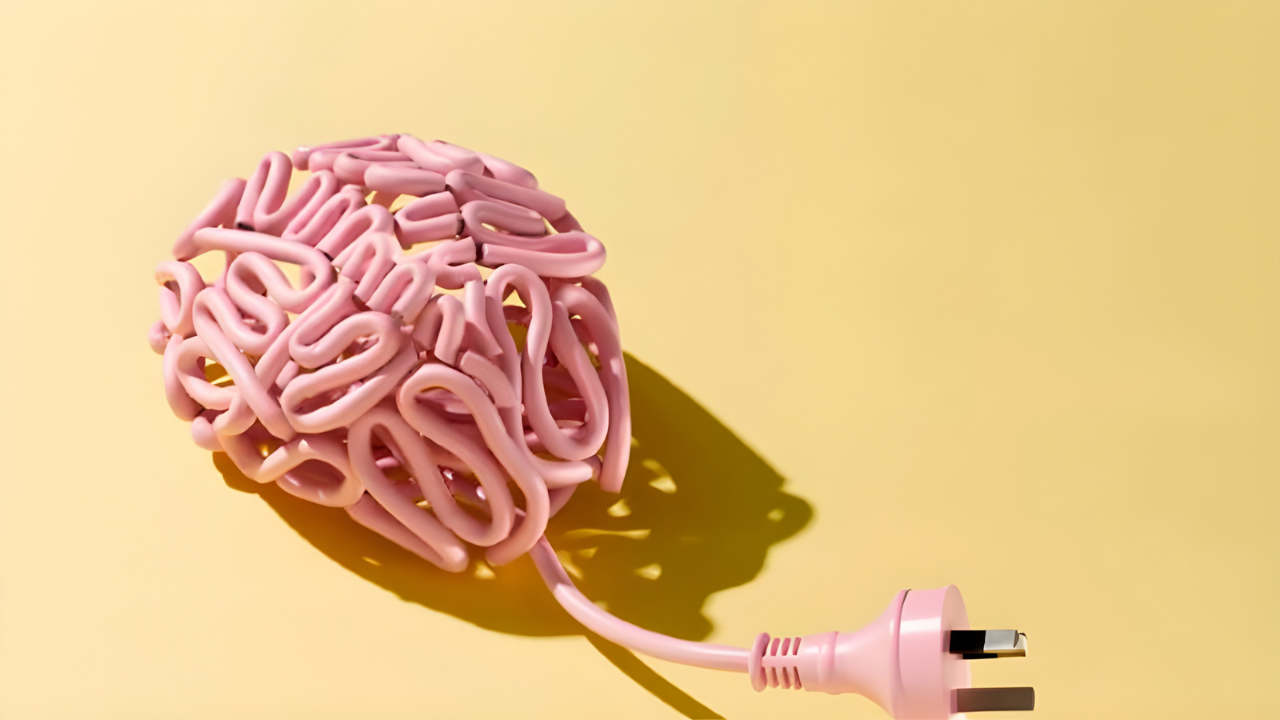
By Lesley Holmes, Founder Beneath The Gloss
Every Thursday, THE BOARD brings you industry insights from our Members to your inbox.
NERVOUS SYSTEM REGULATION AS A COMPETITIVE ADVANTAGE.
This isn't a wellness conversation. It's a performance one.

I care deeply about well-being. I've spent years in the work, and I've lived what happens when chronic dysregulation forces you to stop working entirely. But that's not what I want to talk about today. I want to talk about what you're losing right now. Not in burnout. Not in breakdown. On an ordinary Tuesday, in an ordinary meeting, running on ordinary stress. And more importantly, how regulation isn’t just about health. It’s about competitive advantage.
Here's the biology most performance culture ignores:
The prefrontal cortex is responsible for strategic thinking, creative problem-solving, discernment, impulse control, and long-range planning. In other words, the exact capabilities you are paying senior leaders for.
But under sustained pressure, the sympathetic nervous system activates. Cortisol and adrenaline rise. Blood flow gets redirected away from the prefrontal cortex and toward survival circuitry. What began as a mechanism for acute threat becomes a baseline operating system.
Yale neuroscientist Amy Arnsten's research shows that even mild stress rapidly impairs prefrontal function. Not trauma. Not crisis. The low-grade hum of a full inbox and back-to-back calendar.
Chronic exposure doesn't just impair this region. Over time, it shrinks it. Stress hormones reduce gray matter volume in the prefrontal cortex. The part of the brain responsible for executive function literally loses capacity.
This is not about being tired. It's about being cognitively narrower than you were built to be.
When the prefrontal cortex goes offline, the amygdala takes over, what Daniel Goleman called the "amygdala hijack." The survival brain runs the show. Pattern recognition narrows. Reactivity increases. Big-picture thinking contracts.
THE THING ABOUT STRESS IS THAT IT DOESN’T STAY PRIVATE.

Through emotional contagion and limbic resonance, your nervous system state transmits to the room before you say a word. Teams calibrate to their leaders biologically. A dysregulated leader creates a dysregulated team — ideas retract, people brace, creativity tightens.
And from inside chronic stress, it doesn't feel like dysregulation. It feels like intensity. Urgency. Productivity. It isn't. It's narrowed cognition spreading outward.
WHAT REGULATION ACTUALLY LOOK LIKE IN PRACTICE.

I was deep in a brand strategy not long ago, circling the same problem, trying to force clarity through sheer will. The old pattern would have been to sit longer and push harder.
Instead, I stopped. Went for a long walk by the water. No phone. No input. Just movement and open space.
The solution surfaced fully formed. I came back and rebuilt the strategy in under an hour.
That same pattern later unlocked an agency-wide pricing model that a whole team had been stuck on. Because I gave my nervous system the conditions to access its creative state.
That's not a personality quirk or a lucky walk. That's physiology.
Research shows walking increases creative output by up to 60 percent compared to sitting. Four days in nature without devices improves creative problem-solving by 50 percent. When the nervous system downshifts, the prefrontal cortex comes back online. The connections that stress was blocking become accessible again.
We don't permanently lose intelligence under chronic stress. We lose access to it.
Regulation looks different for everyone. It's breathwork and it's a walk in the woods. It's contrast therapy and it's hot yoga. It's surfing, golfing, or reading a novel. It's art and it's play. It's pushing yourself through hard things so you expand your capacity to handle pressure, and it's knowing when to back off and give yourself space.
You can't live in constant pressure. But you can't live in zero pressure either. The skill is knowing which state you need and being able to move between them intentionally. What it doesn't look like is grinding harder and unwinding with alcohol. Intense exercise spikes cortisol. Alcohol suppresses REM sleep and blunts emotional regulation. Both are managing dysregulation, not resolving it. And most high performers are doing exactly that, and calling it work-life balance.
THIS IS WHAT ELITE PERFORMANCE HAS ALWAYS KNOWN.
Former SEAL Commander Mark Divine introduced box breathing into BUD/S training — a four-count inhale, hold, exhale, hold — because failure rates were extreme and they needed to understand what separated the people who made it from the people who didn't. The answer was regulation. The ability to return to baseline under extreme duress. To hold more capacity without tipping into chaos.
Stanford researchers later confirmed what the SEALs already knew: controlled breathing directly influences the brain structures that regulate emotion, mood, and arousal. A simple, repeatable practice. Profound cognitive and performance impact. Warren Buffett famously spends five to six hours a day thinking and reading. Bill Gates has taken "Think Weeks" since the 1980s, no meetings, no devices, full isolation. He called it CPU time. Major strategic shifts came out of those periods. This is especially urgent right now, in a world of infinite inputs, back-to-back meetings, and an always-on culture that has normalized operating in a low-grade state of overwhelm. A surprising number of leaders spend zero intentional time in quiet. Zero.
Intuition and creativity are quiet. While ego and stress are LOUD. It benefits all of us to cultivate the conditions for our best thinking.
This is not self-care culture. It is cognitive optimization with decades of proof.
THE REFRAME.

Nervous system regulation is not about calming down. It is about expanding capacity.
High performers don't need to be relaxed all the time. They need to be able to move between states intentionally, to handle pressure without losing access to higher cognition. That's the skill. That's the advantage.
And here's what makes this more urgent, not less, in an AI-driven world: AI can execute, optimize, and process. It cannot originate from intuition. It cannot read a room somatically. It cannot sense misalignment before the data surfaces. It cannot connect disparate ideas the way a regulated human brain can. Those capabilities live in the prefrontal cortex. They require regulation to access. And that is precisely what you are paying people for.
The American Institute of Stress estimates workplace stress costs U.S. businesses over $300 billion annually in absenteeism, turnover, diminished productivity, and healthcare. That's not a wellness line item. That's balance sheet erosion hiding in plain sight. The organizations that get ahead of this, that build regulated thinking into how they lead, how they structure time, how they support their teams, are going to have happier people, lower turnover, more innovation, and higher returns. Not as a side effect. As a direct result.
The question isn't whether stress exists. It always will. The question is whether your leadership culture knows how to metabolize it without sacrificing cognition.
If you normalize stress as productivity while the part of the brain responsible for innovation quietly goes offline, you are structurally suppressing your own competitive advantage.
I'm not advocating for less ambition. I'm advocating for access to your full intelligence — and a way of working that feels better while producing more.
The greatest performance unlock might actually be doing less.
Intentionally.
